

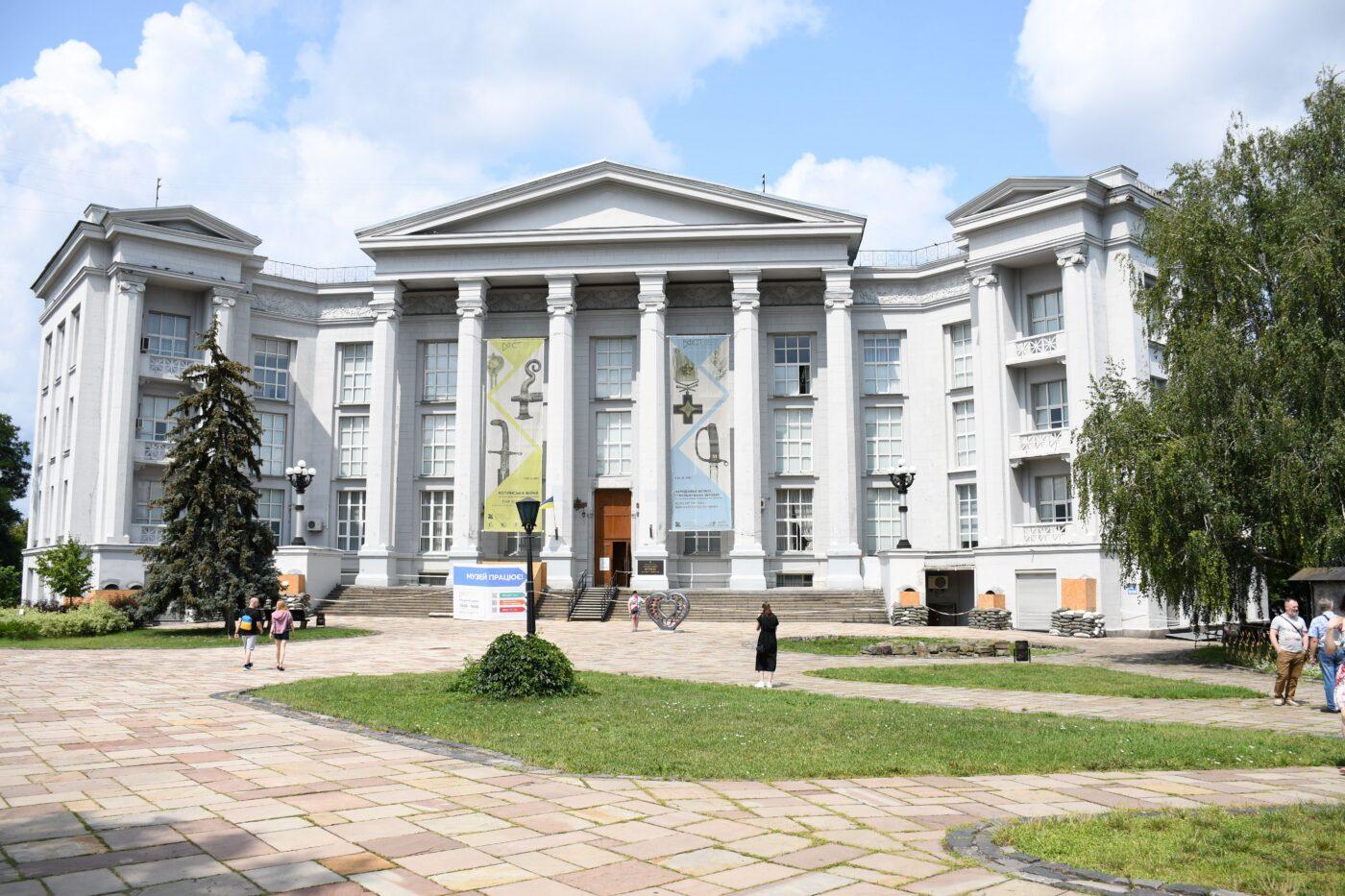
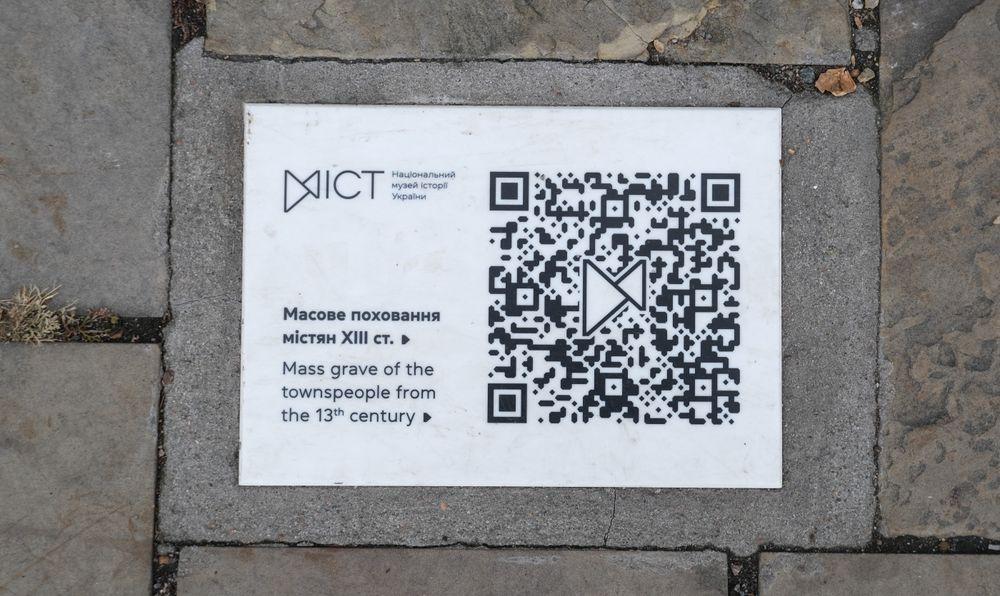
The National Museum of History of Ukraine is located on Starokyivska Gora, one of the oldest parts of the Ukrainian capital. The museum area contains many historical monuments, about which you can learn more by scanning the QR codes on the information boards.
The place where the museum is located has a rich history and is overgrown with numerous historical myths. For example, there is a myth that the ancient center of Kyiv arose in the 5th century. Some researchers have identified the northern part of Starokyivska Gora with the chronicled “Kiya city”. Modern scholars argue that the settlement of this period could hardly claim the role of an urban center. The true appearance of the city was formed on Starokyivska Gora much later. Only at the end of the 9th – beginning of the 10th century. the Starokyivske settlement appeared on this territory. It was a fortified settlement with an area of 1.5 hectares. Today, on the site of the ancient finds, stands the building of the National Museum of the History of Ukraine, built in 1937–1939 according to the design of architect Joseph Karakis as an art school.
The modern appearance of the territory of Starokyivska Gora around the museum is the result of the partial implementation of the project of the park-museum “Ancient Kyiv” by architect Avraam Miletsky, carried out in the 1980s. In particular, the ramparts of the legendary Prince Kyi were reconstructed according to his plan. Once it was part of a defensive system over 200 m long, which ran from one slope of the mountain to the other.
What secrets do princely palaces hide?
At the end of the 10th century, on the expanded territory of the city, the Kiev prince Volodymyr Svyatoslavich began the construction of the first brick church – the Church of the Assumption of the Most Holy Theotokos (Tithe), the Southern and Eastern palaces. There is an assumption that it was in the Southern Palace that the “grid” of the times of Volodymyr Svyatoslavich was located, which was the meeting place of the prince and his wife. The remains of the Western Palace, built at the same time, have also been preserved. It was a large building, with a total area of over 1200 m2, consisting of three separate parts. Presumably, the palace was destroyed as a result of the earthquakes described in the chronicles. Currently, the remains of the foundation of the Western Palace are preserved and are available for viewing on the territory of the museum.
Fragments of the Eastern Palace were discovered by Vikentii Khvoyka in 1907. The palace had a magnificent decoration, marble, fragments of fresco painting and elements of enamel mosaics, round window panes were found there. Due to the subsidence of the slope, it began to collapse even during the princely times.
But the “palace of Princess Olga”, the remains of which were found on the territory of the museum estate in 1970–1972, hardly belonged to the princess. At first, scientists determined the date of its construction no later than 945. However, construction techniques and architectural details indicate that the structure was built no earlier than the 12th century. Therefore, it is possible that different buildings were located on the same site.
Craftsmanship Center of Kyiv
Craftsmen lived and worked on the territory of Starokyivska Gora even before the emergence of the settlement. This is evidenced by part of an adobe oven from a Slavic dwelling of the 8th century. It was discovered during excavations in 2009. The remains of the structure and part of the oven were destroyed by a foundation ditch during the construction of the Tithe Church. At a distance of 40 m south of the left wing of the museum building, you can find a place where the remains of a large kiln for firing ceramics from the 16th–17th centuries have been preserved. The kiln was discovered during excavations by Theodosius Movchanivsky in the summer of 1936. Based on the found fragments of dishes with traces of glazing and bricks, researchers assumed that it was an entire production complex. It was believed that this area was abandoned after the Mongol invasion of 1240. But individual finds of coins, hanging seals, and household items from the 14th–15th centuries, as well as craft complexes from the Lithuanian era discovered during excavations in 2000, indicate that life continued on the territory of Starokyivska Gora.
Myths about the pagan temple and the burial of the princely era
In 1918, Vikenty Khvoyka found the remains of a stone structure on Starokyivska Mountain. The researcher interpreted them as a Slavic pagan temple, and the “pillar” as an altar. His colleague and participant in the excavations, Karl Bolsunovsky, suggested that these were the remains of a sanctuary of the Sun god Svyatovyd. However, in 1937 it turned out that the structure was built using techniques typical of the late Middle Ages. And the so-called “sacrificial pillar” was most likely a layer of debris from a later time. And although this “pagan temple” hardly existed in the past, in the 1980s a modern reconstruction of the temple was created in memory of pagan times.
What definitely existed was a 10th-century burial on the eastern slope of Starokyivska Gora. This is one of the earliest mound burials, and also one of the richest. It was found in 1936, during the excavations of Theodosius Movchanivsky. A man and a woman were buried in the grave. The woman wore a necklace of carnelian beads and coin pendants, silver temple rings, a ring, and a small bronze key. Among the man’s belongings, only a silver fibula and fragments of a shield fitting were preserved. This is due to the robbery of the grave in ancient times. But in the 11th–12th centuries, Kyiv princes and their relatives were mostly buried within the walls of the Tithe Church. Unfortunately, due to the destruction of the church in 1240, it is impossible to clearly establish who exactly the burials belonged to. Petro Mohyla in the 17th century claimed to have found two marble sarcophagi that belonged to Volodymyr and his wife Anna. And already in 1826, outside the foundations of the Tithe Church, another sarcophagus was found with the remains of a skeleton, which was attributed to Princess Olga. The reality of these assumptions is doubtful, since both burials were found outside the church.
Sad evidence of the Mongol attack on Kyiv in 1240 is the four mass graves of Kyivans who died defending the city. Part of the burial was found by Vikenty Khvoyka in 1907. According to Khvoyka’s descriptions, the researchers discovered a huge number of skeletons of different ages and both sexes, starting with children. At the very bottom of the grave was the altar cross of the Desyatyn Church, which they tried to save from the looters of the church.
This work of Byzantine masters of the 10th–11th centuries is part of the MIST collection, and can now be seen at the exhibition “The Church of the Virgin Mary of Desyatyn: Architectural and Artistic Image” on the first floor of the museum.
The Desyatyn Church is the first brick church in Rus’
The church of the Desyatyn Church of the Assumption of the Blessed Virgin Mary was built after the adoption of Christianity in 988. According to recent research, the temple has undergone four stages of reconstruction and rebuilding. Its interior features carved stone slabs of marble and pyrophyllite, stone mosaics, and frescoes. The remains of the foundations were first explored in 1635 on the initiative of Kyiv Metropolitan Petro Mohyla. Subsequent research was conducted by Metropolitan Yevgeny Bolkhovitinov in the early 1820s. After that, a new temple was built on the foundation, as a result of which a significant part of the remains were damaged. After the destruction of the constructed structure by the Bolshevik authorities, Mykhailo Karger continued the excavations of the ancient Russian temple in 1936–1939. Then a secret hiding place was found more than 4.5 m deep from the floor of the church. This hiding place became the last refuge of Kyivans who tried to escape during the Mongol assault on Kyiv in 1240. They had various items with them: jewelry, tools, an axe, a protective helmet, and a unique find – a set of casting molds.

In 2005–2011, the foundations of the church were re-examined by an expedition of the Institute of Archaeology of the National Academy of Sciences. Now the finds from the Desyatyn Church are stored in the collections of various museums, some of them in the MIST.
Modern history of Starokyivska Gora
There are several monuments on the territory of the museum that attract the attention of visitors. In particular, a stone with the inscription “Where did the Russian land go?” near the observation deck. The words on it echo the opening line of “The Tale of Bygone Years” (“Where did the Russian land go, and who first began to reign in it, and how did the Russian land come into being”). Thanks to the author of the chronicle, we also know that one of Prince Volodymyr’s virtues was the spread of writing in Russia. This is evidenced by numerous archaeological finds – hanging seals of Kievan princes with Cyrillic inscriptions, graffiti on household items, spinning wheels or ceramic vessels, writing implements, and, finally, inscriptions on the walls of ancient Russian temples, mostly of a secular nature. In 1988, Vitaly Shishov created a monument that recalls the history of the first school in Russia.
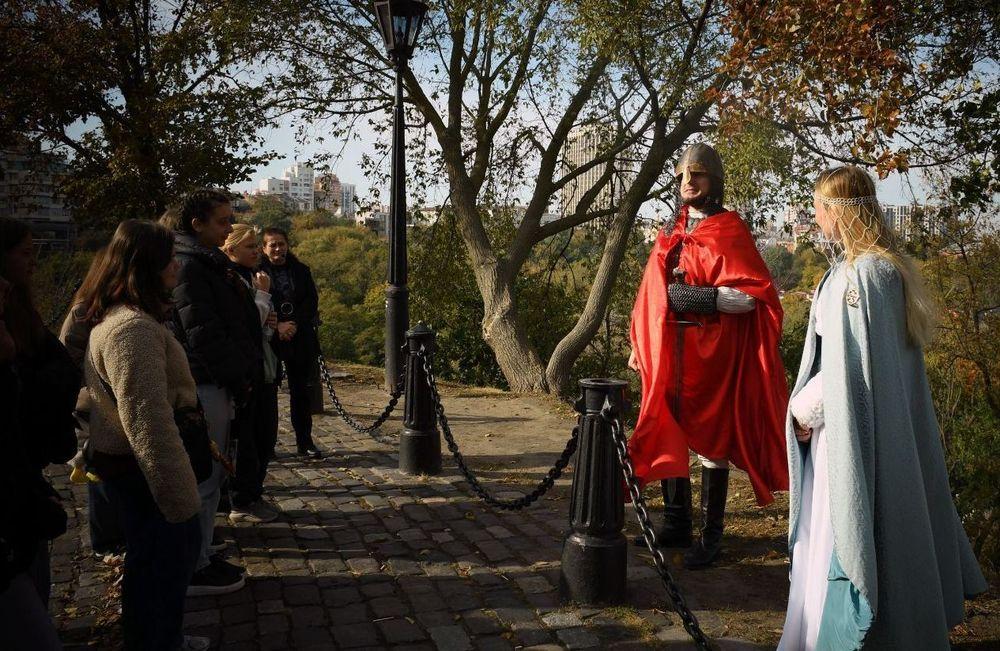
The oldest linden tree in Kyiv adorns the museum’s estate, which, according to legend, was planted by Petro Mohyla himself in the 17th century.
An observation deck has been built behind the museum, where you can enjoy a magnificent panorama of Podil and the Gonchari-Kozhumyaki tract, where artisans lived during the Rus’ era, and now the Vozdvyzhenka microdistrict has been built.