

On Starokyivska Hill in front of the building of the National Museum of the History of Ukraine lie the foundations of the Tithe Church. You get used to them very quickly – so much so that you stop looking at your feet. The stone becomes simply part of the space, although in fact it is the beginning.
Hence it is difficult to talk about history as something distant.
It is not framed in a separate narrative here – it is nearby, in the landscape, in the very place where the city begins.
I enter the museum with this feeling – that history is already present, even before any exposition or text.
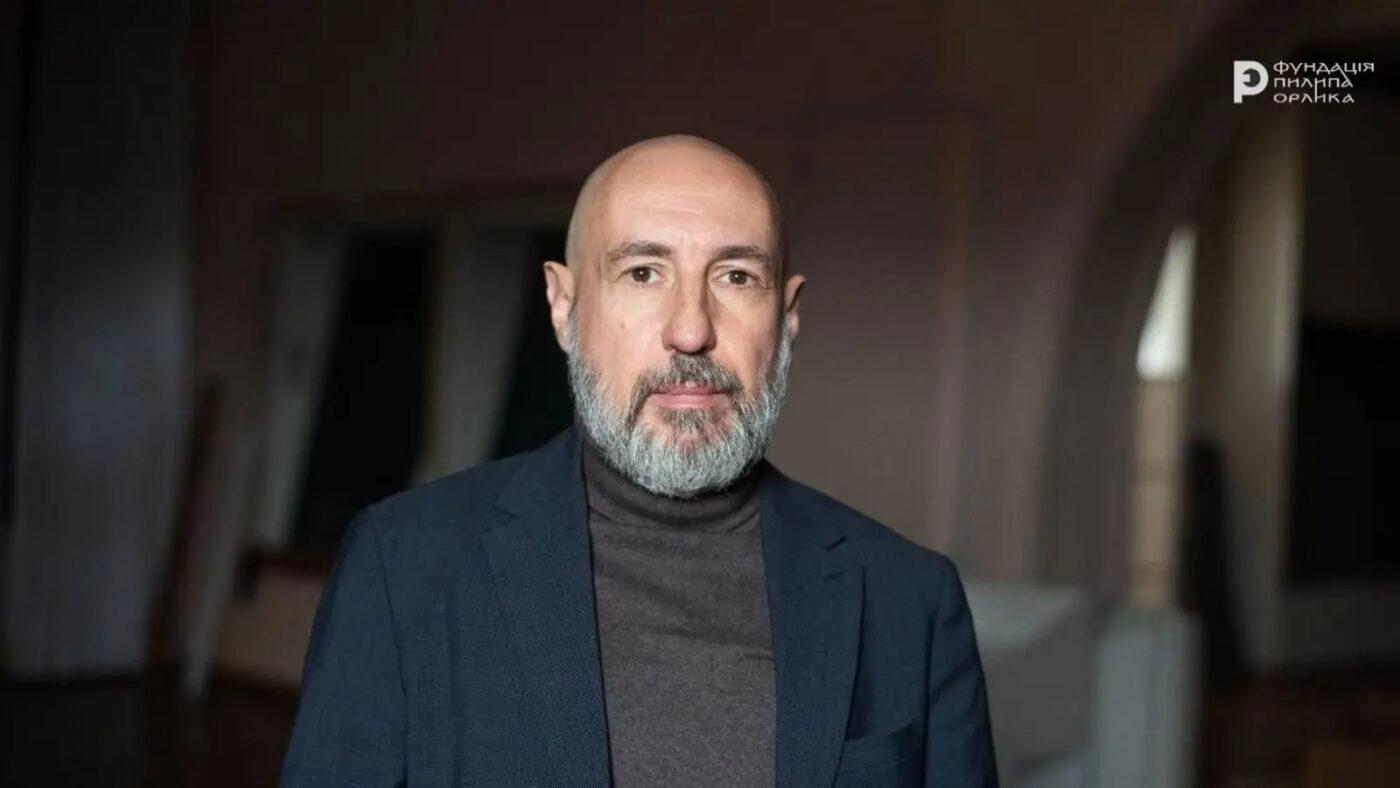
And in this space I talk with Bohdan Patrylyak – Doctor of Historical Sciences, Professor, Deputy General Director for Scientific Work of the National Museum of the History of Ukraine.
O.K. You were born into a family of scientists. Can we say that your historical thinking began in childhood – through conversations in the family? Can you recall any story from your childhood?
B.P. I was born into a family of chemists. My parents’ origins from different regions of Ukraine led to different historical experiences and self-awareness. My father was born in Lemko, a territory of interwar Poland, a year before the start of World War II. In 1946, the family was forcibly relocated to the village of Gai-Roztotski in the Ternopil region. It was here, to a large extent, that my father’s Ukrainian consciousness was formed. Later, Lviv Polytechnic and moving to Kyiv in the early 1960s. I remember when I was in junior high school, in the summer my father and I would walk past the former NKVD building in the town of Zalizki. My father told me that after the war, the bodies of killed rebels were dumped here, exposing them to abuse. I didn’t want to believe it then, given that at school they talked almost every day about the most humane state in the world, the USSR, fighting for peace all over the world. I also remember how local intellectuals would come to my father in the village and look through emigration publications. That was when I first saw the image of the coat of arms of the UNR designed by Vasyl Krychevsky. I already knew that our ancient coat of arms was a trident, but I imagined it in a distorted form; legally, it could only be seen in caricatures of “bourgeois nationalists” in “Perets”, and here such laconic perfection, I was amazed.
My mother comes from Pereyaslav region, was born during the war years. Her family memories concerned the horrors of the Holodomor and the German-Soviet war. I first heard about the genocidal famine from my great-grandmother as a child. Thus, in comprehending family stories from the Lemko region, Ternopil region, and Pereyaslav region, my historical thinking and national awareness were formed.
O.K. You graduated from Kyiv school No. 200. What was the Kyiv of your childhood like? Did you feel then that you were living in a city with a multi-layered history, or did that come later?
B.P. Yes, the legendary two hundredth school in Akademgorodok. Kyiv in the 1970s and 1980s looked different, its historical face was changing before my eyes. My father was interested in Ukrainian history and, being still very young, I visited all the Kyiv memorial sites and museums with him. Although, to be honest, the historical museum did not impress me then. The foundations of the Desyatynna Church and the old image of St. Andrew’s Church without gilding on the baths were etched in my memory. I remembered the Golden Gate before reconstruction. At that time, the Kyiv intelligentsia was outraged by the construction of the so-called Motherland complex, which distorted the Dnieper slopes. Of course, there was a feeling that you were living in an ancient glorious city. But, at the same time, the city was rapidly losing its Ukrainian face, Russification was deepening. Despite the fact that we studied at a Ukrainian school, we mostly communicated with each other in Russian. At home in families — in Ukrainian, and at school during breaks — in Russian. We listened to “enemy voices”, Western music, in high school we drew tridents on our desks (more like Neptune’s), but we communicated in Russian. That’s how deep our complexes were. Unfortunately, they still haunt many Kyivans, Ukrainians by spirit and origin.
O.K. In 1989, you became a co-founder of the Union of Independent Ukrainian Youth in Kyiv. Did you feel that you were inside the historical process?
B.P. Of course it was. Back then, in the late 1980s, we were young people with radical views who realized our national identity and returned to our native language in communication. We were inspired by the ideas of Ukrainian nationalism, read the hitherto inaccessible works of Ukrainian historians and sought decisive immediate action, often facing criticism and misunderstanding from older fighters for independence, who professed a gradual, evolutionary path of struggle. It is nice that most of our then “extremist” ideas have now become elements of state policy.
O.K. Can we say that your experience in the Union of Independent Ukrainian Youth actually pushed you towards history — not as an abstract discipline, but as a way of understanding what you were already directly involved in?
B.P. Everyone in one way or another participates in the creation of history. For me, it was and is important to awaken the interest of Ukrainians in their own history, in rethinking certain pages of it from a Ukrainian angle. For example, the history of World War II still requires a new Ukrainian reading, the same goes for the history of Ukraine during the Soviet period.
O.K. Your dissertation is devoted to the resistance of the Ukrainian peasantry in 1927–1933. Do you see direct parallels between this period and modern Ukraine?
B.P. The parallels are that Putin, like Stalin at one time, decided to punish the Ukrainian people for disobedience and creating obstacles to the implementation of the Russian imperial project. Instead, Ukrainians have resisted and are resisting this desperately. In the early 1930s, Ukrainians practically thwarted Stalin’s project of complete collectivization through mass demonstrations and uprisings, jeopardizing the further modernization and development of the Russian-Bolshevik empire. The genocidal Holodomor was the response to the peasant resistance. The Revolution of Dignity, followed by heroic armed resistance to the aggressors, shattered Putin’s plans for the revival of the Russian empire within the former USSR and further dominance in Eastern Europe.
O.K. How should a museum act when history is not happening in the past, but right now — as it was in 2022?
B.P. The first duty of museum workers is to protect cultural values. So, in the event of a threat, they are primarily obliged to save museum collections. It is important that the institution’s management has the courage to take responsibility and take decisive steps. We remember how people react differently to the start of hostilities. Someone stood in line at the military registration and enlistment offices, while someone loaded their belongings into a car and headed west. According to museum instructions, any movement of exhibits outside the museum takes place only with the approval of the Ministry of Culture. But what to do in an emergency situation when contact with ministerial officials is lost? Some museum directors were inactive, following the letter of the instructions, while others in the east and south practically saved collections from shelling. The main thing is to have a team of like-minded, motivated employees in a difficult situation.
O.K. What happened to the exhibits in the first days of the full-scale invasion? How were they saved?
B.P. On February 24, 2022, more than 50 employees arrived at the museum, the phones of the Ministry of Culture were not answered, and a decision was made to dismantle the exhibits in the main building of the museum and its branch. The most valuable items were packed in boxes for evacuation, the rest were transferred to storage facilities. On March 1, the then Minister of Culture Oleksandr Tkachenko proposed to the museum management via zoom to evacuate the collections. The first stage of the evacuation took place on March 4 thanks to the direct efforts of Oleksandr Tkachenko and the Minister of Internal Affairs Denys Monastyrsky, practically in manual mode. The second stage of the evacuation was on March 12, although the complete dismantling of the exposition continued until the end of the month.
O.K. Were there protocols for evacuating museum collections in 2022? Can you tell us about this period?
B.P. Yes, there was an evacuation commission, lists of museum objects were compiled by value categories. On the eve of a full-scale invasion, we worked out various scenarios of action. We even discussed what to do if the connection was lost. Fortunately, this did not happen. But practice has shown that in conditions of stress and uncertainty, algorithms developed in advance do not always work. Therefore, the most valuable resource in such situations is people who are ready and able to work in extreme conditions.
O.K. You are the deputy director of the country’s main museum. What does your typical day look like – is it more about the office or about working with the collection?
B.P. In fact, there are different days. Work is carried out in the office, in the storage rooms, and in the exhibition halls. After the full-scale invasion and dismantling of the permanent exhibition, the museum switched to the format of individual exhibitions, which were formed from objects that were not evacuated. We managed to create dozens of exhibition projects. Thanks to this, the museum has resumed active work, accepting visitors during this difficult time. Today we are preparing another exhibition, so I work more with exhibits.
O.K. What does the path of an exhibit to the museum look like – from the moment it is found or transferred to the moment it appears in the showcase?
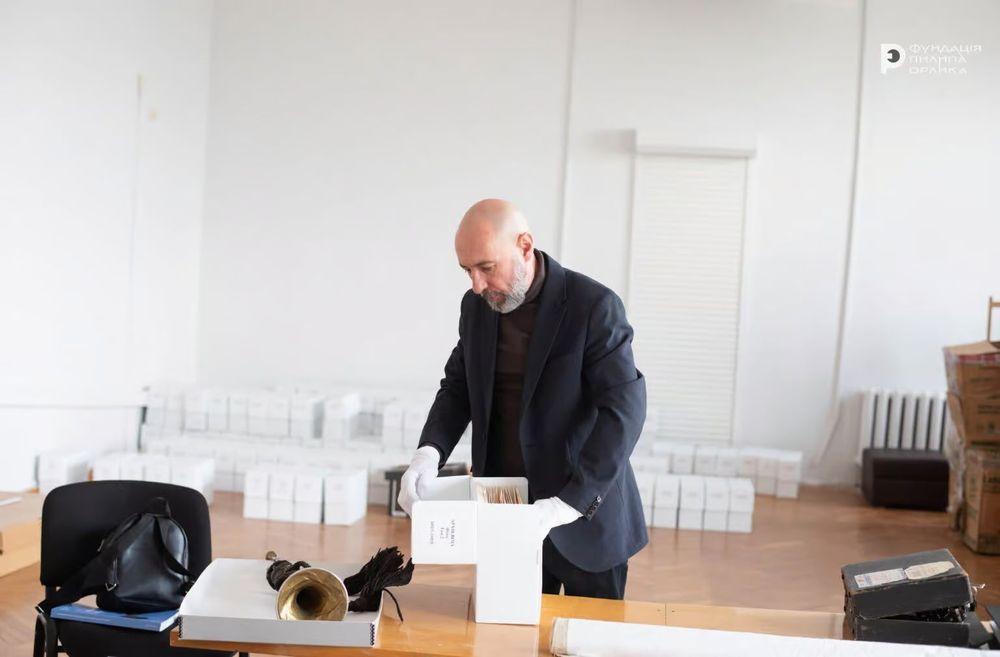
B.P. The fate and path of exhibits are different. The museum contains objects that came to the institution at the first stages of its creation at the end of the 19th century, when the families of patrons Khanenko and Tereshchenko, Vikenty Khvoyka and others donated their collections. The exhibits arrive thanks to planned acquisitions, the work of archaeological and ethnographic expeditions. Today, thousands of objects are transferred to the museum by law enforcement and customs authorities. After the first entry into the museum, the object undergoes a registration and inventory procedure. If necessary, restoration and conservation measures are carried out. Only after that we are able to demonstrate the exhibits to visitors.
O.K. Where are most of the exhibits actually stored — the ones we don’t see in the halls? What do these collections look like?
B.P. Most of the exhibits are stored in storage rooms. These are specially equipped rooms depending on the nature of the objects. Storage rooms are equipped with shelves, cabinets, and safes. Unfortunately, in our museum they are critically overcrowded.
O.K. Is it true that we see only a small part of the collection in the exposition? What is the approximate percentage?
B.P. The exposition usually demonstrates the most valuable part of the collections when it comes to peacetime. Most of the exhibits are stored in storage rooms and are used in temporary exhibitions. In our museum, a significant part of the valuable exhibits needs restoration (it would not be entirely correct to exhibit them in their current form), but the museum’s restoration capabilities are, unfortunately, limited. Before the large-scale Russian invasion, the museum had about 16,000 items on display and 10,000 in the branch “Treasury of the National Museum of the History of Ukraine”. In total, the museum collection consists of more than 800,000 items. That is, a little more than three percent was on display. In other museums, this proportion may be higher in favor of the exhibition.
O.K. Are there situations when an exhibit exists, but it is impossible to exhibit it? Why? Can you tell us about such an interesting exhibit?
B.P. If we are not talking about security issues, then it is primarily the state of preservation of the object. When there is a threat of destruction or loss of the exhibit, it will be more comfortable for it to be in storage. For example, in our collection there is a unique object – a well-known bracelet made of mammoth tusk with a meander ornament (18 thousand BC) from the Mizyn site. It was found in 20 fragments, underwent complex restoration. Mammoth tusk is a very fragile organic material, requiring strict adherence to temperature, humidity and light conditions. Therefore, we did not exhibit it in the permanent exhibition. The French Louvre’s model workshop made a wonderful copy of it, which was exhibited on a permanent basis.
O.K. How is an exhibition born: is it the idea of one person or the work of a team?
B.P. Usually, the idea for an exhibition originates from one person. But from the idea to its practical implementation, a number of stages pass. The author of the idea shares it with colleagues, a discussion takes place, new ideas appear, an understanding is gained of which objects can be used to reveal the idea. Next, a scientific concept of the exhibition is developed and a design project is prepared. At the same time, work is underway to select exhibits. The concept is considered by the museum’s scientific and methodological council, where experts express their comments and wishes. Fund employees select objects and compile accompanying documentation. Artists and designers develop visual material, banners, posters, booklets, labels, and are directly involved in the installation.
O.K. How long does it take on average to prepare one exhibition — from the idea to the opening?
B.P. It all depends on the scale of the exhibition. We have a format of mini-exhibitions, when literally several showcases are prepared for a certain historical date. The construction of such a display can take literally a few days. The preparation of complex exhibitions, in particular serious international projects, can take several years.
O.K. To what extent is an exhibition a scientific work, and to what extent is it a direction and dramaturgy?
B.P. Everything is important in an exhibition: a scientific idea, an artistic decision, informative content, a text of the excursion. An exhibition is a harmonious combination of all these components.
O.K. How often does the exposition change? And what causes these changes?
B.P. In our museum, before the events of 2022, there was a so-called a permanent exhibition that told about the history of Ukraine from the Stone Age to the present day, and temporary exhibition projects. Despite the fact that the exhibition is called “permanent”, over time it requires changes and adjustments, or a complete renovation.
During the Soviet era, re-exhibitions were often carried out for ideological reasons on orders from above. For example, a large-scale change in the exposition was carried out in the last years of the Stalin era in 1952. At that time, the museum was headed by a professional Bolshevik propagandist, Olga Krychevska. Among the arguments in favor of changing the exposition was that the current exposition did not sufficiently reflect “the centuries-old friendship of the Ukrainian people with the great Russian people, the world historical significance of the Great October Socialist Revolution, Stalin’s friendship of peoples, and the struggle against the enemies of the Ukrainian people — Ukrainian bourgeois nationalists.”
Of course, after Ukraine gained independence, the exposition also changed. Ukrainian historical science developed, narratives changed, and the museum was replenished with new artifacts. The exposition also underwent significant changes after the Revolution of Dignity and the beginning of Russian armed aggression. But, if we ignore ideological motives: exhibition equipment becomes outdated over time, design techniques improve, and new digital technologies appear. Therefore, any permanent exhibition in a museum is not eternal.
O.K. Can the same exhibit “tell different stories” in different exhibitions?
B.P. This happens very often. In one exhibition, an object can illustrate an era, in another – tell about technology, in a third – about the person to whom it belonged. Under different circumstances and contexts, an exhibit has its own interpretation.
O.K. How is the language of the museum changing – do we have to rethink existing exhibits?
B.P. Expositions have to be periodically rethought. This is facilitated by the arrival of new materials, scientific processing of fund collections, new scientific achievements. Ultimately, history is being rethought at the level of society.
O.K. Who works with exhibits every day – besides historians? What are the professions that we do not think about?
B.P. It is not only historians who work with exhibits. The role of the historian is crucial when building an exhibition — writing a scientific concept, scientific attribution of objects. The exhibits are directly taken care of by employees of the fund departments in the fund storage facilities. They can be museologists or art historians by profession. They are engaged in their research, museum accounting, description, arrangement, dust removal, monitor compliance with the proper temperature and humidity regime, etc. Many objects are in such a condition that only the talented hands of restorers can bring them back to life — give them an exhibition appearance, continue their existence through restoration and conservation. In order to properly present the exhibit to the visitor, artists and designers work with it, who directly mount the exhibition. Today, the museum is actively digitizing the collection, so photographers work with the objects. Large-sized exhibits are moved by employees of engineering departments. Therefore, most employees work with museum objects.
O.K. How is the restoration done? Can you give an example?
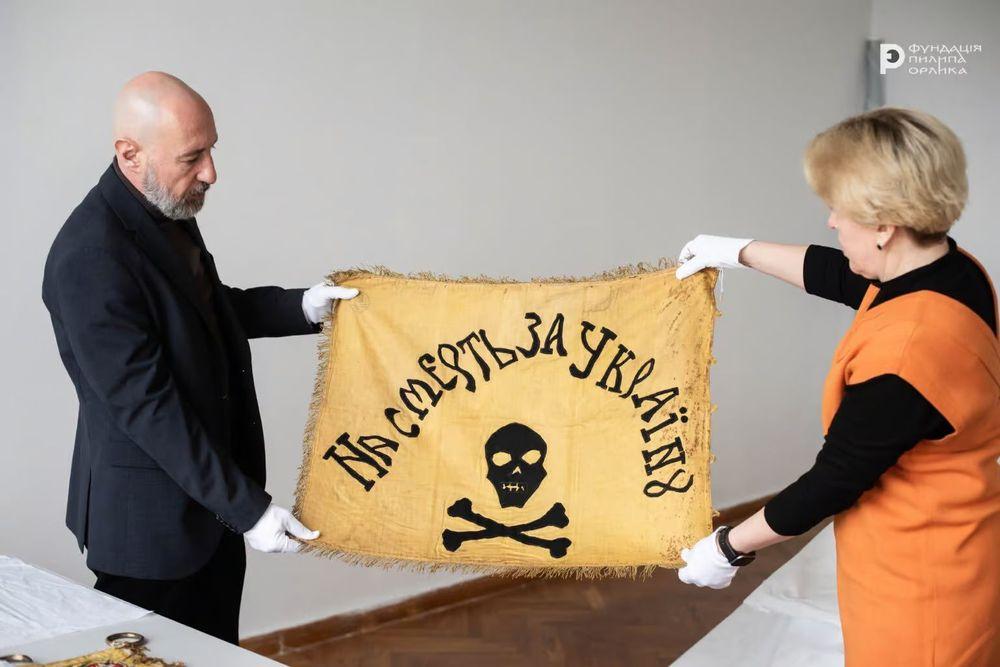
B.P. It all depends on the condition of the object. It could be its cleaning to give it an exhibition appearance, which does not last long. Often the object undergoes several restorations. Objects in poor condition or complex unique objects are restored over the years. For example, for two years, one of the flags from the era of the Ukrainian Revolution of 1917–1921 was restored – the flag of the Zaporozhian Regiment, created in 1917 in Moscow from Ukrainian soldiers, which came to our museum from the collection of the Museum of the Liberation Struggle in Prague.
O.K. The museum received the collection of the Ukrainian Free Academy of Sciences in Canada. Can we say that this is not just a transfer of exhibits, but a return of historical memory to Ukraine?
B.P. I would say that this is a replenishment of our historical heritage. To a large extent, we have already managed to return historical memory to ourselves. This collection began to take shape in the 1920s, when the Government of the UNR in exile created the Ukrainian Military Historical Society to collect materials and study the history of armed struggle in the modern era. In 1948, the Society’s work was continued by the Ukrainian Military Historical Institute, headed by the General-Coroner of the UNR Army Mykhailo Sadovsky. At the same time, a “Will” was drawn up on the transfer of the institution’s materials to Ukraine after its liberation from foreign captivity. In 1969, the collection was transferred to the UVAN in Canada. We are glad that Ukraine has finally received this unique collection. Among the relics of the liberation struggle of the Ukrainian Revolution of 1917–1921 are: battle banners of the UNR Army, military awards, personal belongings of military and political state leaders, and unique documents.
O.K. The exhibition about Symon Petliura, which is being prepared based on the collection of the Ukrainian Free Academy of Sciences in Canada, is a complex and resource-intensive project. What role does the support of partners and patrons play in its implementation?
B.P. The museum is extremely grateful to the Pylyp Orlyk Foundation for the support provided in the preparation of this exhibition project. Thanks to it, the exhibition halls are being renovated, modern display equipment with special lighting is being manufactured, printing will be done at the proper level, and an information kiosk is being used. Unfortunately, the museum is in a rather difficult financial situation, so the role of partners’ support is difficult to overestimate.
O.K. Can you tell us about three exhibits that impressed you in this collection?
B.P. I was impressed by the collection as a whole. People, having lost their homeland and being in exile, did a titanic job of studying and memorializing the armed struggle of Ukrainians in the 20th century, and museumized its artifacts. These people, former soldiers of the Ukrainian armies, despite everything, continued to believe in gaining independence, carrying the Ukrainian idea in the free world.
Among the items, I would like to highlight the regimental banner of the First Sich Hetman Petro Doroshenko of the Blue Division Regiment of the UNR Army. It was made in regimental workshops in Germany. After arriving in Ukraine, it was used in ceremonies with the participation of Chief Ataman Symon Petliura. Among the relics of the Ukrainian Revolution are the banner of the First Winter Campaign of the UNR Army, Symon Petliura’s typewriter.
O.K. Is there a difference between how a historian and an ordinary visitor read an exhibition?
B.P. There are different historians and visitors. Everyone reads this subject-spatial system in their own way. Just as we individually perceive a separate work of art or read a literary work.
O.K. For you, is Kyiv more a city of memory or a place where history is happening right now?
B.P. Without historical memory and its revival, perhaps the fateful events that will determine the further course of both Ukrainian and world history would not have happened today. Therefore, Kyiv for me is both about memory and about the creation of history today.
O.K. Are there specific places in Kyiv that are personally significant to you — where you especially feel the continuity of history?
B.P. A significant place, first of all, is the Kyivsky Ditynets on Starokyivska Gora, where we are now. Here our medieval state was created, princely palaces were built, the first stone church in our lands. It was during this period of history that we waged perhaps the most important historical struggle with our enemy. It is enough to recall the special sentiment of the Moscow dictator towards the Rurikovichs.
O.K. Has your perception of these places changed over time — along with your own path in history?
B.P. I only realized the significance of these places more deeply. Especially after our defense forces managed to repel the enemy invasion of Kyiv. After the liberation of Kyiv region, the first exhibition in the museum was dedicated to those events based on the results of the expedition to Bucha, Irpin, Borodyanka, Dymer. The exhibition was called “Invasion. Kyiv Shot”. Its core idea was that Ukrainians managed to repel the new “Mongol” invasion of Kyiv, and the invader’s boot did not set foot on the Kyiv hills, the foundations of the Tithe Church.
O.K. In your experience, what shapes history more strongly: great events or the daily actions of people who often remain unnoticed?
B.P. A difficult question. These are interrelated things. The people are formed, change, grow, and, finally, become the subject of great historical events. But this gradual growth is the result of painstaking daily individual and collective work.
O.K. And, perhaps, the simplest question: what do we never see in a museum — but without what does it exist?
B.P. This is the work of the museum team behind the scenes. After all, an attractive exhibition or an interesting excursion is the final product of the long work of many people. Very often we encounter a misunderstanding of the work of museum workers. Sometimes people believe that museum workers simply store or guard objects. Or even hide them in storage rooms from the public. In fact, a museum is a complex organism, under the operational management of which are hundreds of thousands of exhibits. Their preservation, restoration, scientific study and exhibition require considerable effort.
I came to the museum to talk to a historian.
And I leave with the feeling that history is not only about the past and not only about big names.
It begins much earlier – in family memory, in childhood impressions, in urban space, in those things that at first seem random, but then turn out to be decisive. And, perhaps, that is why it is so important that history is not just remembered, but studied – carefully, deeply, without simplifications.
After this conversation, the continuity is especially acutely felt.
Not as a beautiful metaphor, but as a living tissue that is very easy to damage – and very difficult to restore. That is why the work of a historian, museum, archive, researcher is so important: not to let this continuity break, to be able to see connections where others see only individual fragments.
The interview with Bohdan Patrilyak was conducted by Olena Kyrychenko
Source Kyiv news