

Accessibility menu
Large text
Line spacing
Text spacing
Text alignment
Inversion
Black and white
Saturation
Contrast
Highlighting links
Hide image
Hide video
Cursor
Founding of the Treasury
Excavations of the Scythian Mound
It is believed that the Treasury of the National Museum of History of Ukraine owes its foundation to a significant event in Ukrainian archaeology – the excavations of the Scythian elite mound of the 4th century BC in the city of Melitopol in 1954.
The excavations were conducted by the famous Ukrainian archaeologist, founder of the Kyiv school of Scythologists Oleksiy Ivanovich Terenozhkin (1907–1981).
Two tombs were examined in the mound, in which archaeologists found about four thousand gold items. The most outstanding find is the upholstery of a goryt (a case for a bow and arrow) with images of scenes from the life of the Greek hero Achilles.
Thanks to the firm position of Ukrainian scientists, the valuable finds remained in Ukraine. And some time later, after the transfer of finds from the Melitopol Mound to the Kyiv Historical Museum, its employees were asked to prepare an exhibition of precious metal products from the museum’s collection.
Gold upholstery of a gory from the Melitopol mound
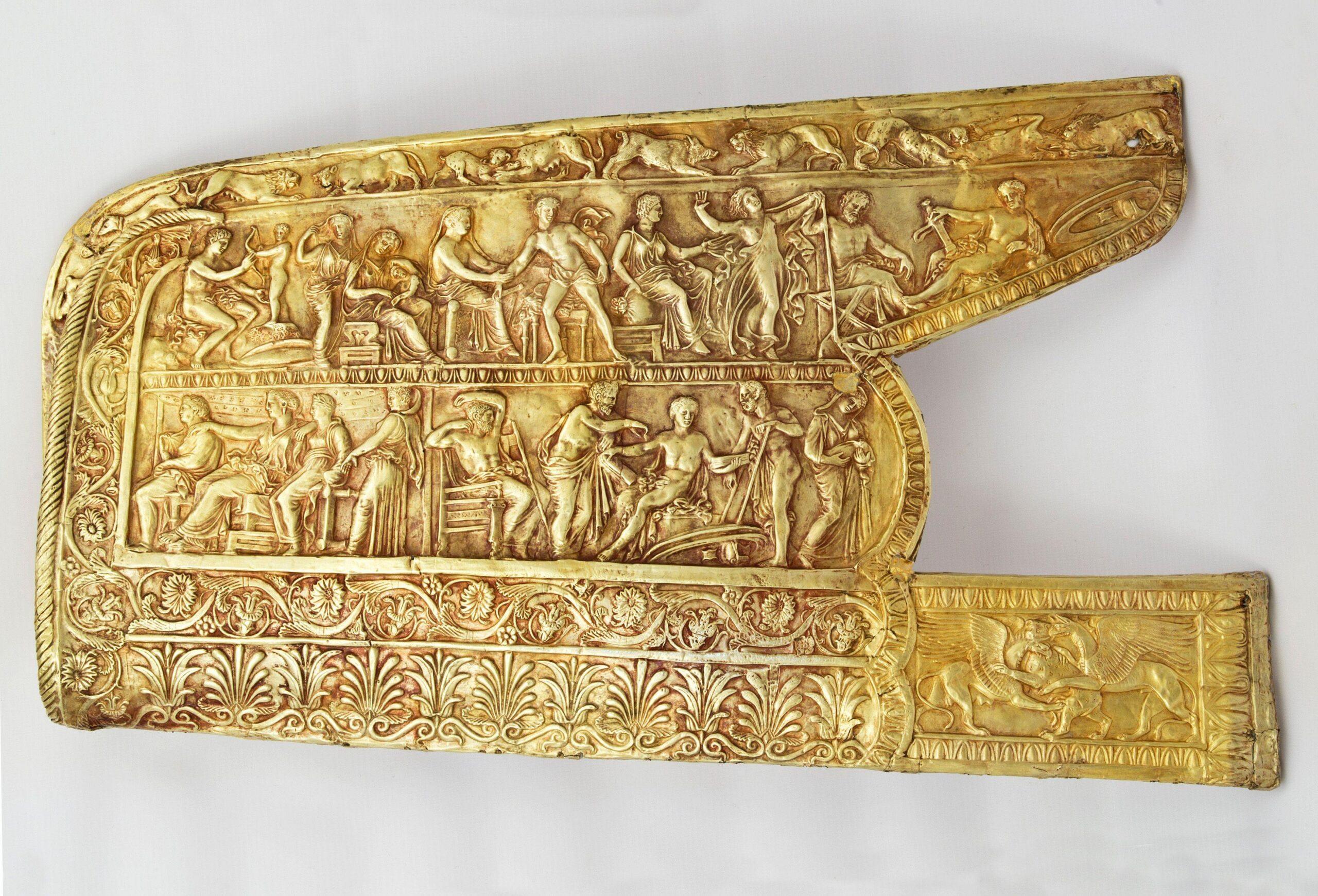
Gold upholstery of a gory from the Melitopol mound
Museum of Historical Treasures of Ukraine
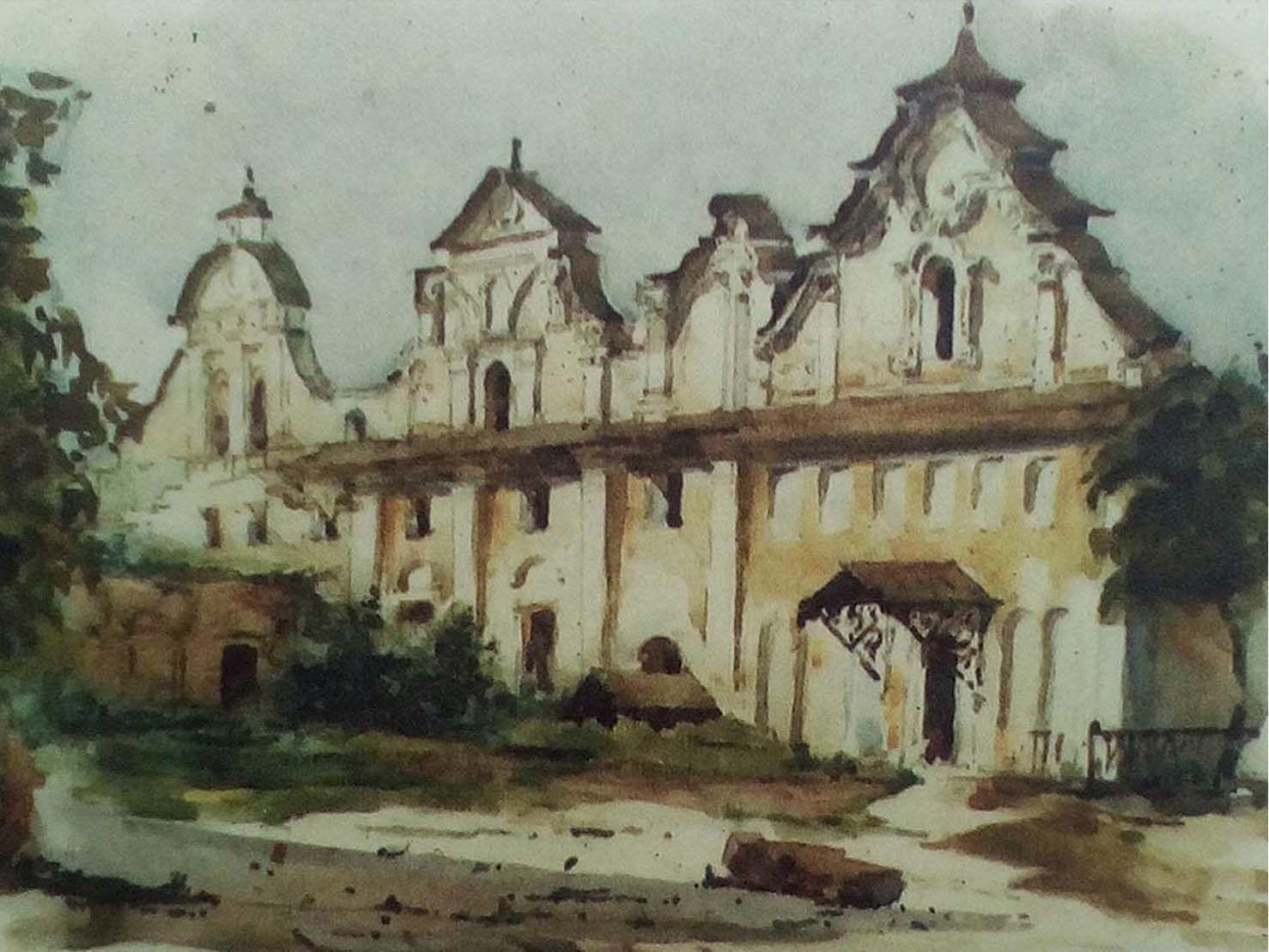
Yevheniya Plamenytska “Kovnirovsky building. Kyiv Pechersk Lavra”. Watercolor. 1963
Founding a new museum
On November 22, 1963, the Council of Ministers of the Ukrainian SSR adopted Resolution No. 1300 “On the establishment of a special department at the Kyiv State Historical Museum – the “Golden Pantry”.
In 1965, the historical museum was named the State Historical Museum of the Ukrainian SSR, and its branch – the status of the museum “Golden Pantry”.
A Baroque architectural monument on the territory of the Kyiv-Pechersk Historical and Cultural Reserve – the Kovnir Building was chosen to house the future museum. It was built in the 1720s–1740s by the Ukrainian builder Stepan Kovnir, most of the building was occupied by the monastery bakery.
In the 1920s–1940s, the Kovnirovsky Building was part of the “All-Ukrainian Museum Town” – an association of museums operating in the premises of the nationalized Kyiv Pechersk Lavra. During World War II, the Kovnirovsky Building was severely damaged and required complete restoration.
Yevheniya Plamenytska “Kovnirovsky building. Kyiv Pechersk Lavra”. Watercolor. 1963
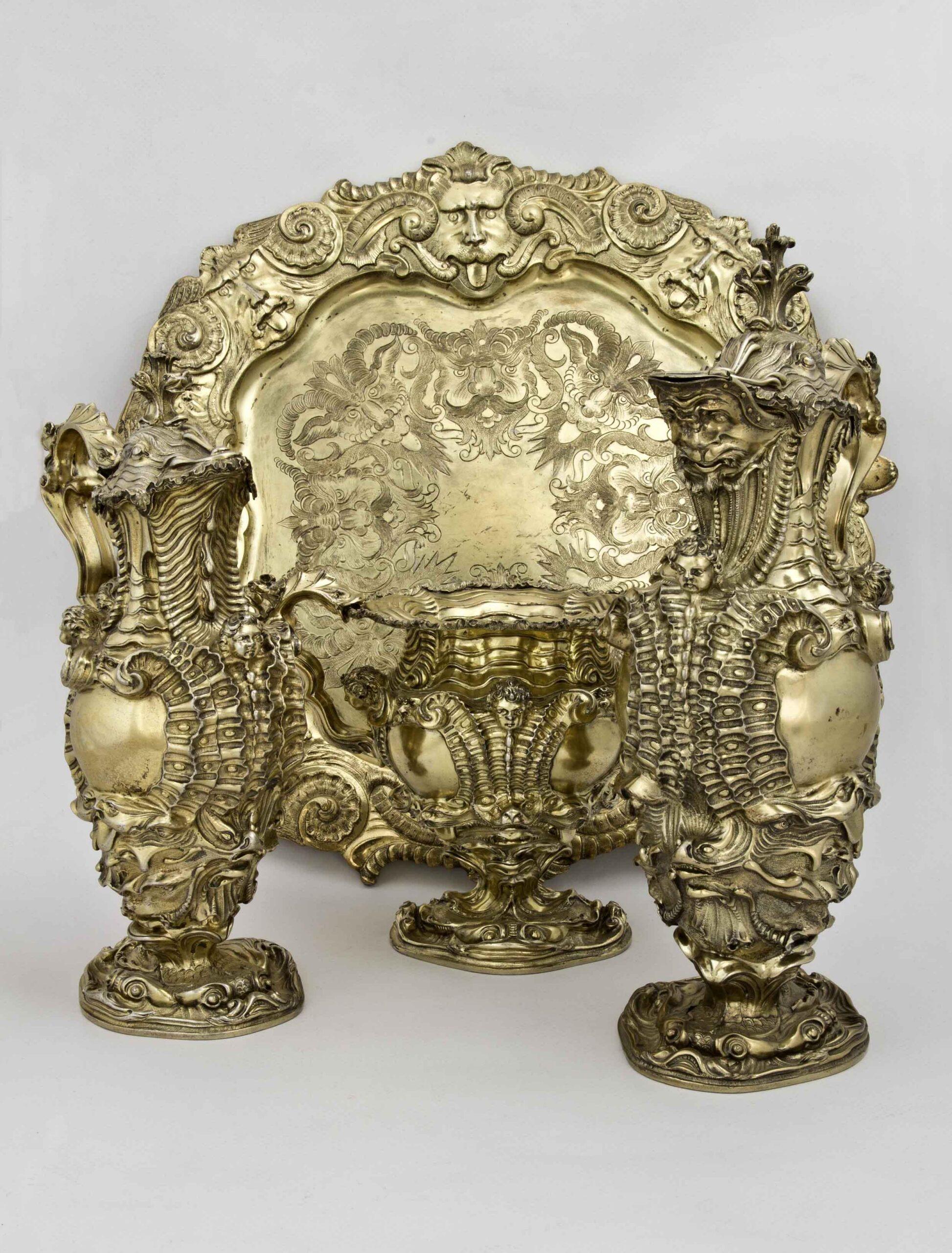
SILVER TABLEWARE SERVICE. Vienna. Mid-19th century
Formation of a collection of precious metals
According to the resolution of the Council of Ministers of the Ukrainian SSR of 1963 on the establishment of the “Golden Pantry”, it was decided to form a collection based on valuables donated to the new institution by all museums of Ukraine.
The collection of the Kyiv State Historical Museum, founded at the end of the 19th century, was taken as the basis.
The archaeological component of the new museum collection was supplemented by receipts from the Institute of Archaeology of the Academy of Sciences of the Ukrainian SSR. Thousands of valuable works from pre-Scythian times to the late Middle Ages were transferred to the museum fund.
Many rare works of ancient masters came from other Ukrainian museums, in particular from Bakhchisarai, Ivano-Frankivsk, Kerch, Lviv, Odessa, Poltava, Kharkiv, Kherson and Chernihiv. A total of 21 museum institutions contributed to the creation of the new museum’s collection.
SILVER TABLEWARE SERVICE. Vienna. Mid-19th century
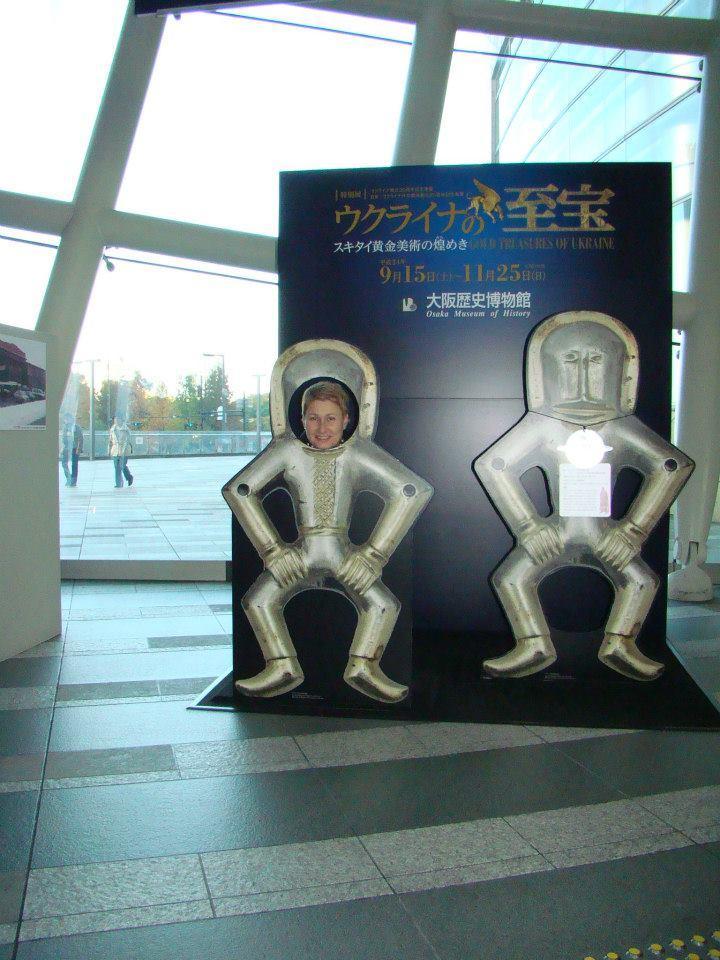
Poster for the exhibition "Golden Treasures of Ukraine" in Osaka, Japan. 2011
Museum of Historical Treasures
In 1968, according to the order of the Ministry of Culture of the Ukrainian SSR No. 70, the museum was renamed the Museum of Historical Treasures of the Ukrainian SSR.
On January 4, 1969, the newly created museum opened its doors to the first visitors.
With the restoration of independence in 1991, the institution was named the Museum of Historical Treasures of Ukraine – a branch of the National Museum of History of Ukraine.
In the 1990s and 2000s, the museum’s valuable collection became Ukraine’s calling card in the world.
The museum was visited by presidential, parliamentary, and government delegations from many countries. Its exhibits have represented Ukraine more than 70 times at exhibitions from North America to the Far East: in Austria, Denmark, Great Britain, Italy, Canada, Lithuania, Luxembourg, the Netherlands, Germany, South Korea, Poland, Singapore, the USA, Hungary, France, Finland, Switzerland, and Japan.
In 2004, with the support of the Foundation of the President of Ukraine, the institution underwent a general renovation and the exposition was significantly updated.
Poster for the exhibition "Golden Treasures of Ukraine" in Osaka, Japan. 2011
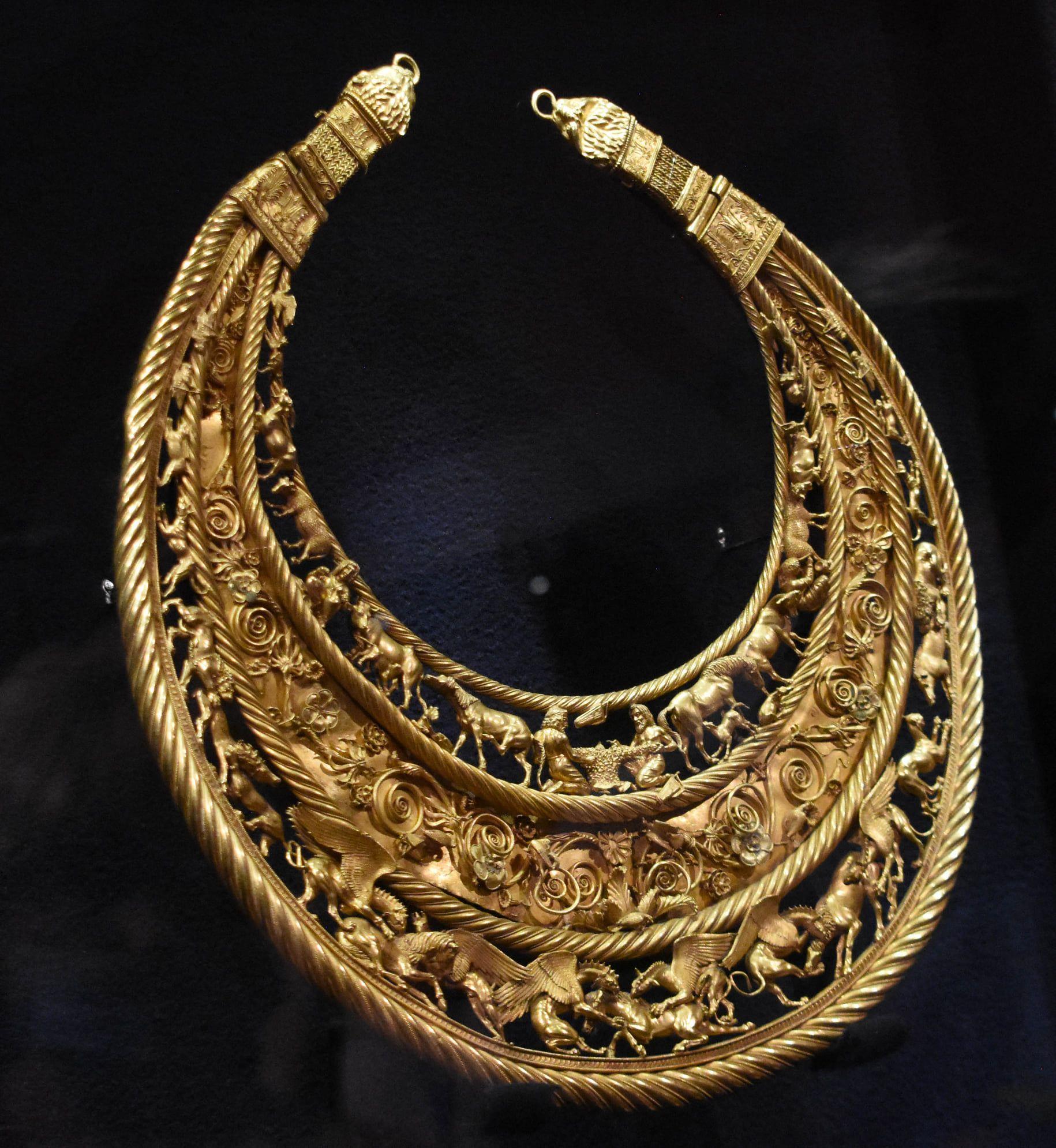
Pectoral from a thick grave mound
Collection of Scythian Antiquities
The museum’s collection of valuables from the Scythian period is perhaps the largest in the world.
These objects were found during archaeological research of Scythian mounds in various regions of Ukraine. In the 19th and early 20th centuries, excavations were carried out by Mykola Ivanyshev, Vikenty Khvoika, Serhiy Mazaraki, in the 1950s–1980s by expeditions of the Ukrainian Institute of Archaeology, led by Vasyl Bidziley, Yuriy Boltryk, Galina Kovpanenko, Boris Mozolevsky, Vitaly Otroshchenko, Oleksiy Terenozhkin, Mykola Cherednychenko and others, in the 1980s by expeditions of Dnipropetrovsk and Donetsk universities.
The most famous Scythian exhibits in the collection are the pectoral from Tovsta Mogila, the bowl from Gaimanova Mogila, the upholstery of a goryt from the Melitopol Mound, the mysterious ritual object from Perederievova Mogila. As well as thousands of ornaments, weapon decorations, and horse bridles.
Pectoral from a thick grave mound
Museum exhibitions
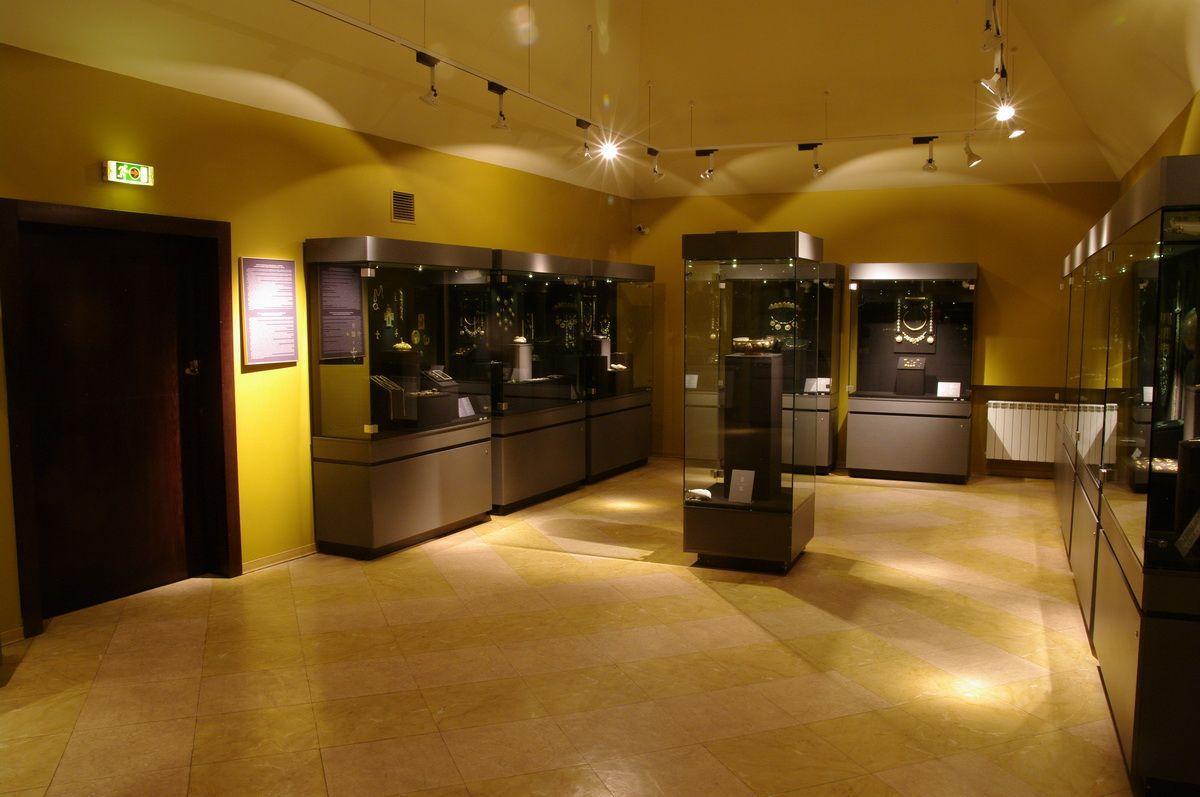
Exhibition "Jewelry Art of Ancient Russia"
Ancient times
The main part of the museum exposition is the collection of “Scythian gold”: valuable weapons, horse bridles, dishes, decorative elements of clothing, jewelry from the 7th–4th centuries BC. e.
The pearl of the exposition is the chest ornament of a Scythian ruler – a gold pectoral from the Tovsta Mohyla mound in the Dnipropetrovsk region.
Historically connected with the Scythians are also collections of objects from the ancient cities of the Northern Black Sea region (Chersonesos, Panticapaeum, Olbia) and Sarmatian mounds.
An important part of the collection is a small but unique collection of jewelry from nomadic peoples who lived in the Ukrainian steppe in ancient times – the Huns, Avars, Khazars, Pechenegs, Polovtsians. Gothic antiquities of the Crimea are also presented.
The collection of jewelry from the times of the ancient Slavs (items from the Martynov, Khariv and Pastyrsky treasures) and medieval Rus (primarily from the Sakhniv treasure) is special.
Exhibition "Jewelry Art of Ancient Russia"
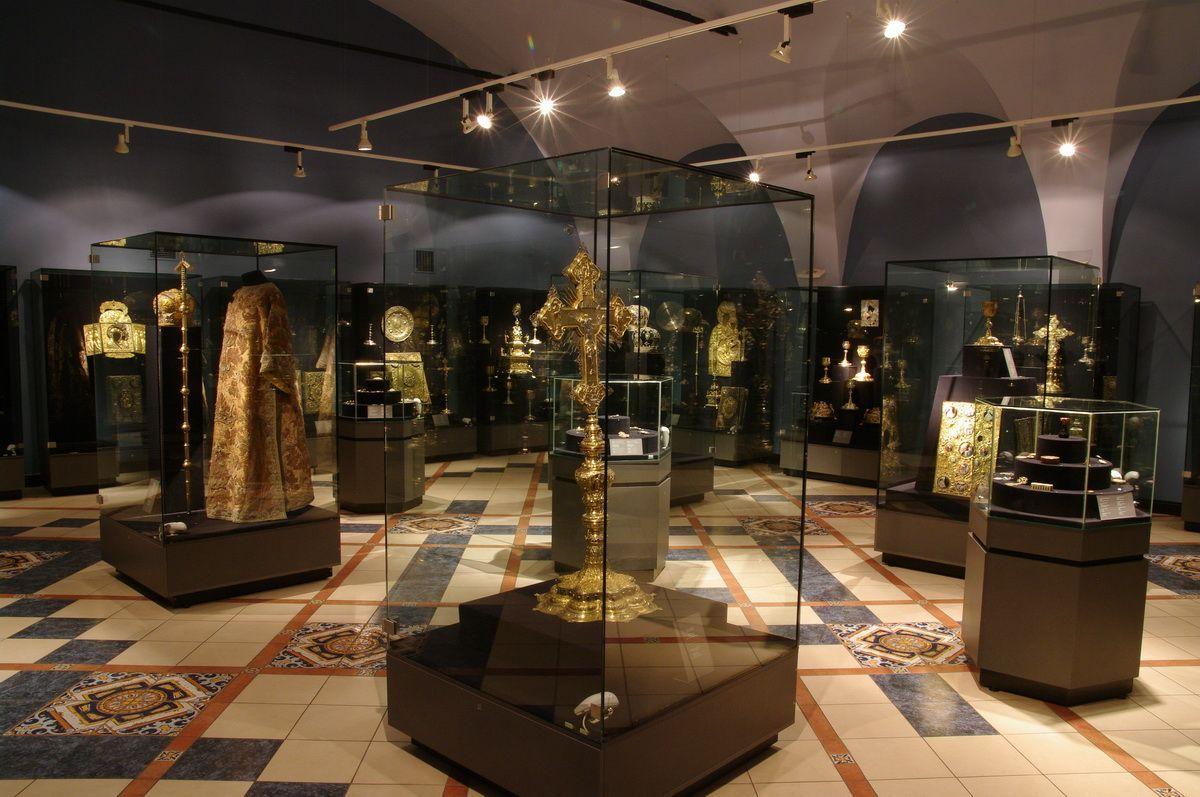
In the exhibition "Jewelry Art in Ukraine in the 16th-20th Centuries"
Jewelry Art of the 16th–20th Centuries
The largest, sixth, hall of the museum presents a collection of precious works by Ukrainian silversmiths of the 16th–19th centuries: Ivan Ravych, Ieremia Biletsky, Matviy Narunovych, Fedor Levytsky and others. Here you can see many objects related to outstanding historical figures – Metropolitan Petro Mohyla, Hetmans Ivan Samoilovych, Ivan Mazepa and Danylo Apostol, Colonels Vasyl Zolotarenko, Rodion Dumytrashko and Stepan Tomara, the families of Rozumovsky, Kochubey, Khanenko, Branytsky and others.
A special place is occupied by the collection of precious works by masters of Germany, Poland, France and other European countries.
In the 1990s, new sections appeared in the museum’s exposition: Jewish ceremonial silver and traditional products of Crimean Tatar craftsmen.
In the last, ninth hall, exhibitions of modern jewelry art are occasionally held.
In the exhibition "Jewelry Art in Ukraine in the 16th-20th Centuries"
The museum today
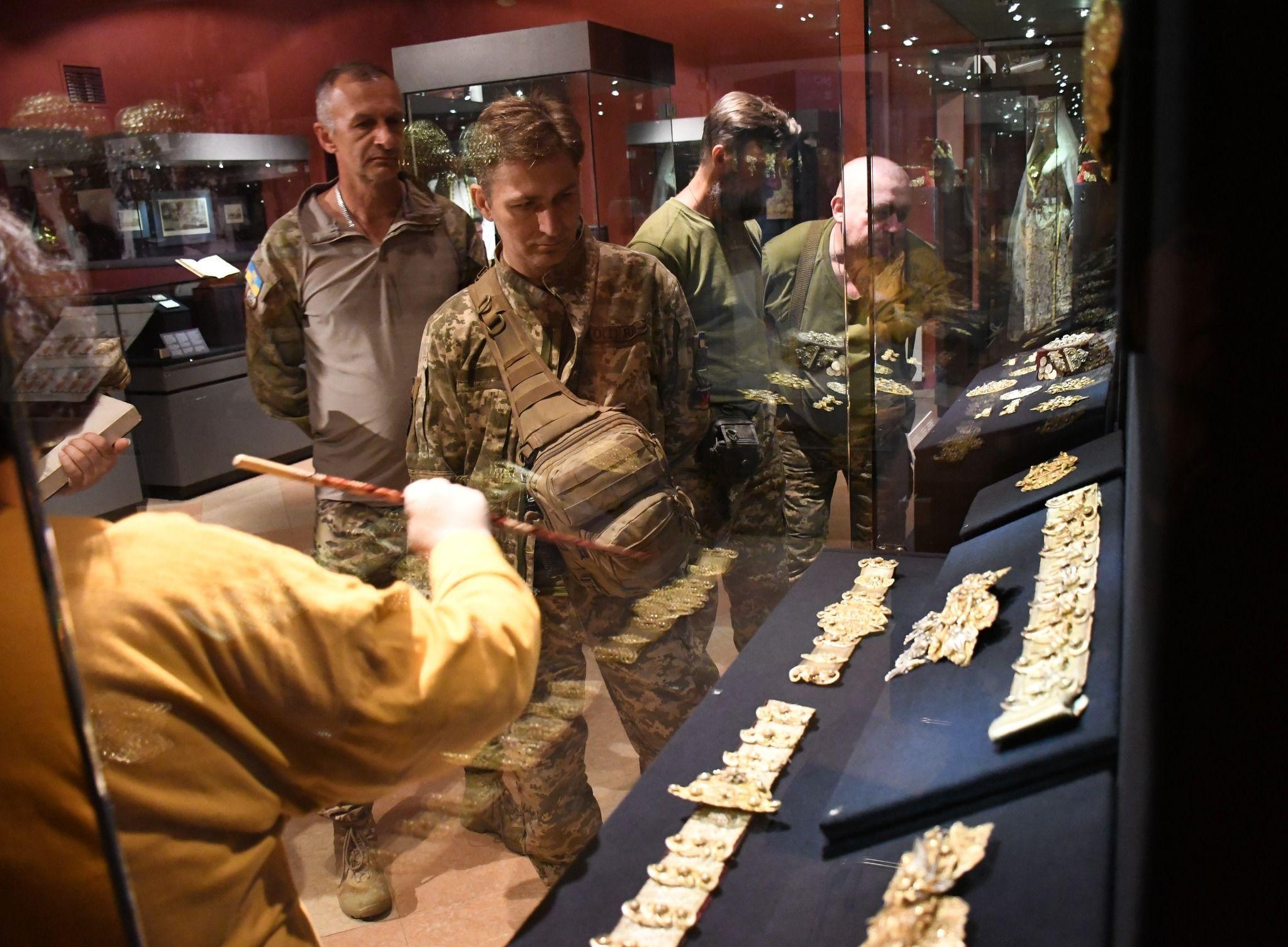
At the exhibition "Miras. Heritage"
Treasury of the National Museum of the History of Ukraine
On September 1, 2021, the institution underwent a structural reorganization, which was named: Treasury of the National Museum of the History of Ukraine – a branch of the National Museum of the History of Ukraine.
Over the 60 years of its existence, the museum has formed a collection of 57 thousand storage units, some of which are unique. Restoration was carried out, which made it possible to preserve priceless treasures for future generations. The museum became a center for scientific research into the history of jewelry art.
The war changed the rhythm of the museum’s life. In 2022, in the first days of Russia’s full-scale invasion of Ukraine, Treasury employees ensured the preservation and evacuation of the valuable collection.
After the liberation of the Kyiv region, the permanent exhibition was replaced by temporary exhibitions that tell about unique archaeological artifacts preserved by Ukraine, about Crimean Tatar culture, and Ukraine during the time of Hetman Mazepa.
At the exhibition "Miras. Heritage"